
Raup Coiler II
This page introduces Raup's shell mathematical model:
Introduction
Raup model parameters
Importance and impact of Raup's work
Introduction
Raup model parameters
Importance and impact of Raup's work
Introduction
The Raup-Michelson model mathematically describes the shapes of the shells of numerous species using four numeric parameters. It was developed by paleontologist David M. Raup and researcher Arnold Michelson and first presented in 1965 in their article "Theoretical Morphology of the Coiled Shell," published in the journal Science. The model was also referenced in subsequent publications by its authors.
This work marked the beginning of modern theoretical morphology, radically transforming the discipline by pioneering the use of computational methods and mathematical modelling to study evolution.
This work marked the beginning of modern theoretical morphology, radically transforming the discipline by pioneering the use of computational methods and mathematical modelling to study evolution.

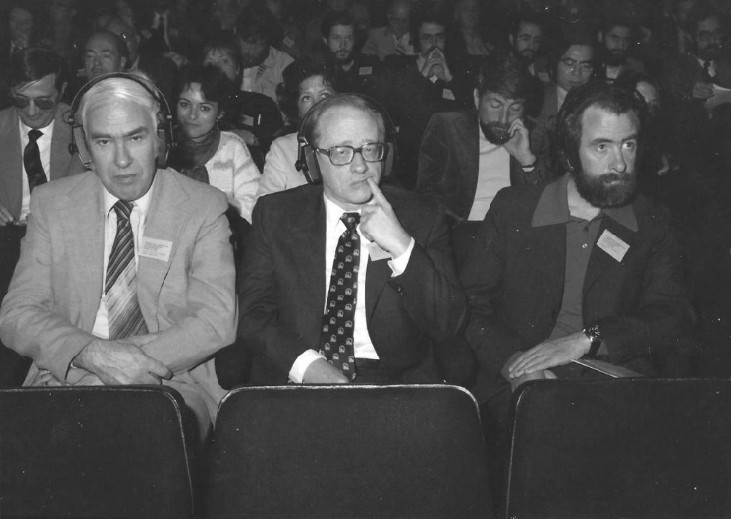
In the left picture: David M Raup holding an amonoid. In the right picture: David M Raup between colleagues Anthony Hallam at the left and Richard Bromley at right.
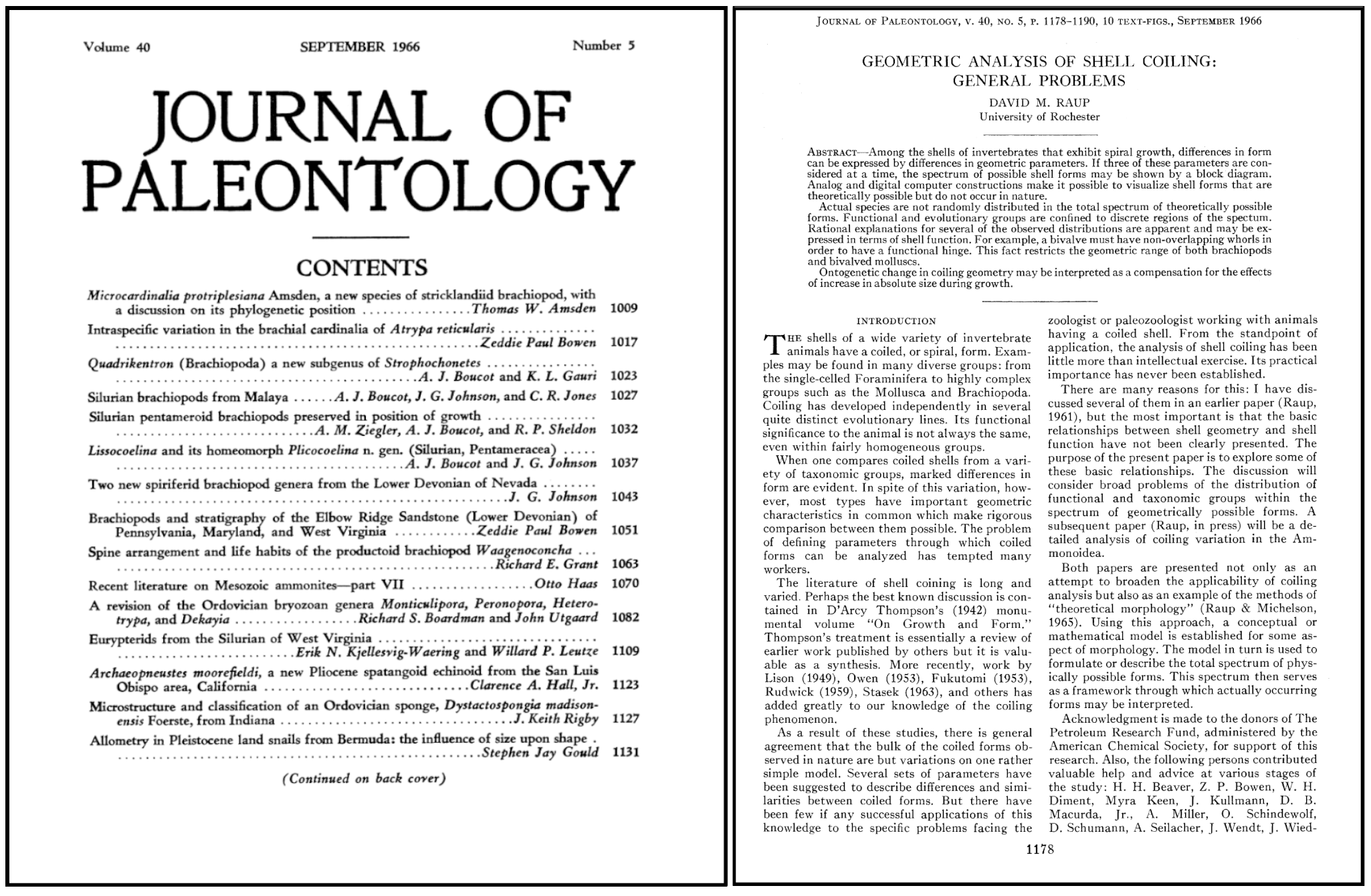
Cover of one of the Raup's articles dedicated to the shell coiling model.
Before this study, the shapes of fossils and organisms were described in purely qualitative terms. Raup and Michelson showed that the complex three-dimensional geometry of mollusk shells (such as snails, ammonites and nautiluses) could be reduced to a simple mathematical model built on fundamental parameters. This started a trend that improved the objectivity, precision and speed of analysis of the subsequent work in the field of theoretical morphology.
Raup model parameters
Raup's logarithmic shell coiling model (Raup, D. M. (1966). Geometric Analysis of Shell Coiling: General Problems. Journal of Paleontology, 40, 1178-1190.), defines shells geometry with 4 fundamental parameters: W, D, T and S
W: Whorl Expansion Rate, is the rate at which the shell whorl increases in size during each complete revolution around the coiling axis. It determines how rapidly the shell expands as it grows.
D: Relative Distance from the Coiling Axis, the position of the generating curve relative to the coiling axis. It influences the degree of overlap between successive whorls and the width of the umbilicus (the central opening of the shell).
T: Whorl Translation Rate, is the rate at which the generating curve moves along the coiling axis during each complete revolution. It determines the degree of vertical displacement between successive whorls, distinguishing planispiral from helicospiral shells.
S: Shape of the generating curve, defines the ellipticity of the generating curve, which represents the cross-sectional profile of the shell whorl (or aperture). It determines whether the whorl has a circular, elliptical or other geometrical shape. When '1' the generating curve is a perfect circle, when smaller than '1' it becomes an horizontal ellipse, and when greater than '1' it becomes a vertical ellipse.
W: Whorl Expansion Rate, is the rate at which the shell whorl increases in size during each complete revolution around the coiling axis. It determines how rapidly the shell expands as it grows.
D: Relative Distance from the Coiling Axis, the position of the generating curve relative to the coiling axis. It influences the degree of overlap between successive whorls and the width of the umbilicus (the central opening of the shell).
T: Whorl Translation Rate, is the rate at which the generating curve moves along the coiling axis during each complete revolution. It determines the degree of vertical displacement between successive whorls, distinguishing planispiral from helicospiral shells.
S: Shape of the generating curve, defines the ellipticity of the generating curve, which represents the cross-sectional profile of the shell whorl (or aperture). It determines whether the whorl has a circular, elliptical or other geometrical shape. When '1' the generating curve is a perfect circle, when smaller than '1' it becomes an horizontal ellipse, and when greater than '1' it becomes a vertical ellipse.
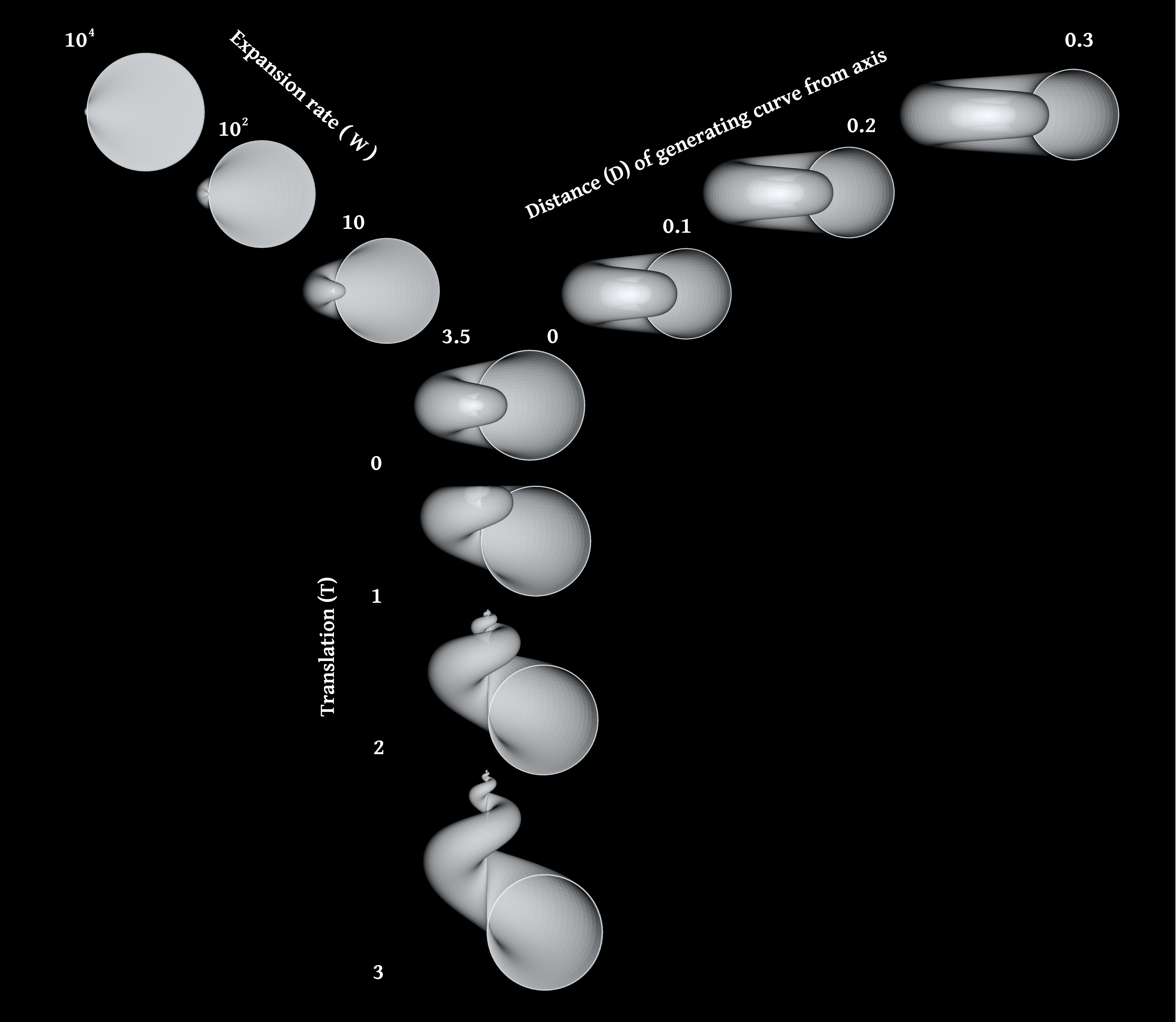
Adapted from Geometric analysis of shell coiling: General problems, by D. M. Raup, 1966, Journal of Paleontology, 40(5), p. 1182
Importance and impact of Raup's work
In the words of Jesús Marugán Lobón, Professor at the Universidad Autónoma de Madrid specializing in vertebrate evolution and morphology, geometric morphometrics and 3D digital reconstruction, the study of Raup's model today:
"... serves to decouple macroevolution from the direct extrapolation of gradual microevolution (Gould), and to visually illustrate two essential problems of macroevolution:
Along the same lines, it has several pedagogical advantages:
"... serves to decouple macroevolution from the direct extrapolation of gradual microevolution (Gould), and to visually illustrate two essential problems of macroevolution:
- 1. The range of the possible versus the actual: most of the theoretical morphospace is empty. This shows that evolution does not produce every conceivable geometric form.
- 2. Distinguishing macroevolutionary causes: it allows students to formulate hypotheses as to whether the empty regions are due to developmental constraints, physical/geometric constraints, or natural selection against poorly functional phenotypes.
Along the same lines, it has several pedagogical advantages:
- 1. A recurring misconception among students is to assume that every trait exists because it is 'optimally adapted.' Theoretical morphology establishes an independent null hypothesis: first the geometric universe of possible forms is generated, and then one analyzes which portion of it has been occupied by life (i.e., moving beyond pan-adaptationism).
- 2. It teaches graphically that macroevolution is not just about counting species or taxa (taxonomic diversity), but about quantifying the variety of anatomical designs in phenotypic space (morphological disparity) (i.e., the difference between disparity and diversity in macroevolution).
- 3. Morphospace allows students to visualize how phylogenetically distant clades (e.g., brachiopods and bivalves, or ammonoids and gastropods) converge on the same viable regions of theoretical space due to similar functional requirements.
- 4. It is a tool for literacy in computational and quantitative modeling: i.e., as the foundational example of generative modeling, with just a few simple mathematical variables one can simulate the morphogenesis of an enormous evolutionary radiation..."

